Why standing still is also bad for you
The standard advice — stand more, sit less — misses the point. Standing still for three hours is its own problem: blood pools, feet ache, knees lock, and by hour two most people are leaning on one hip with the other leg cocked out sideways, which is a worse posture than sitting.
What actually helps is movement. Shifting weight, changing stance, moving your feet.
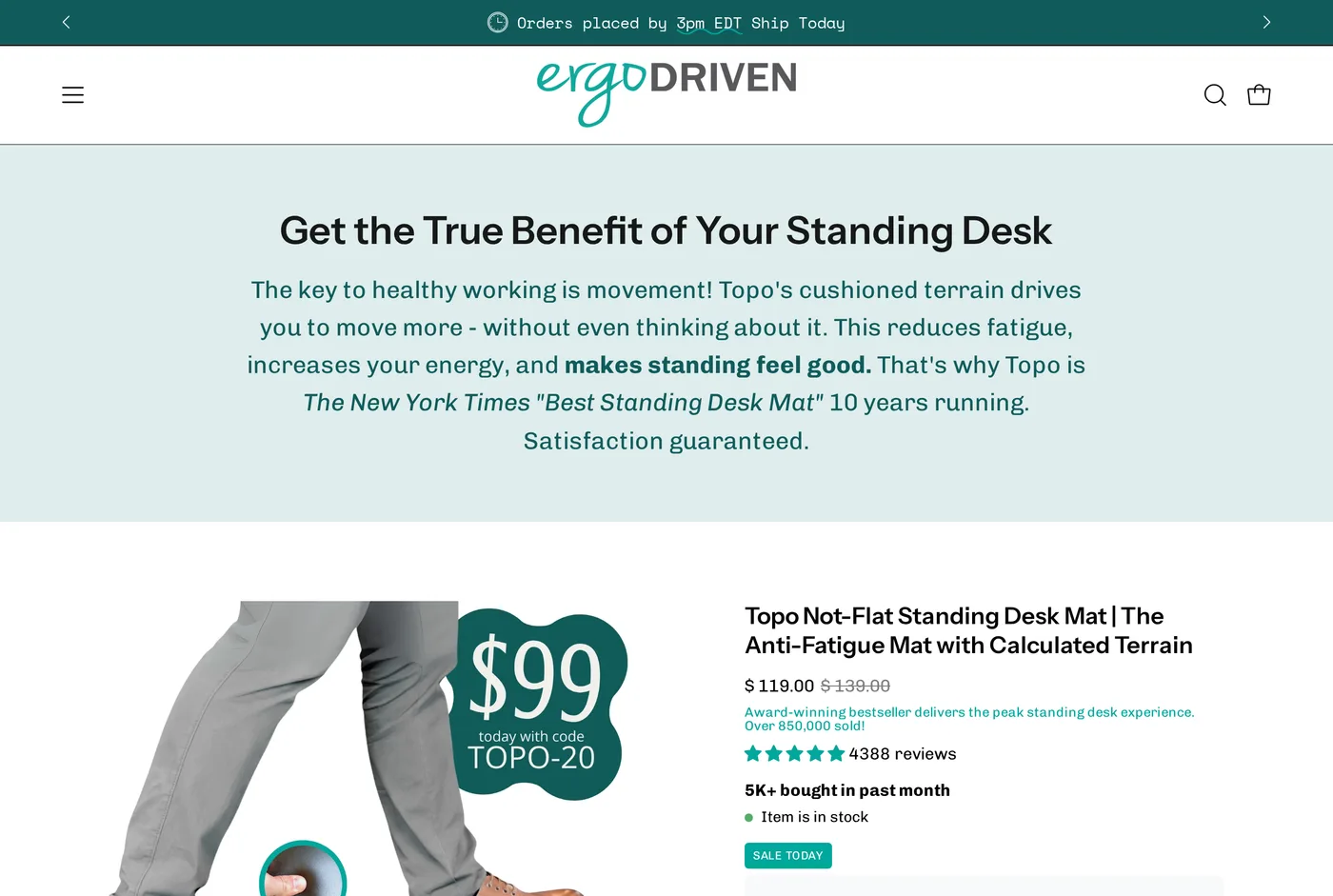
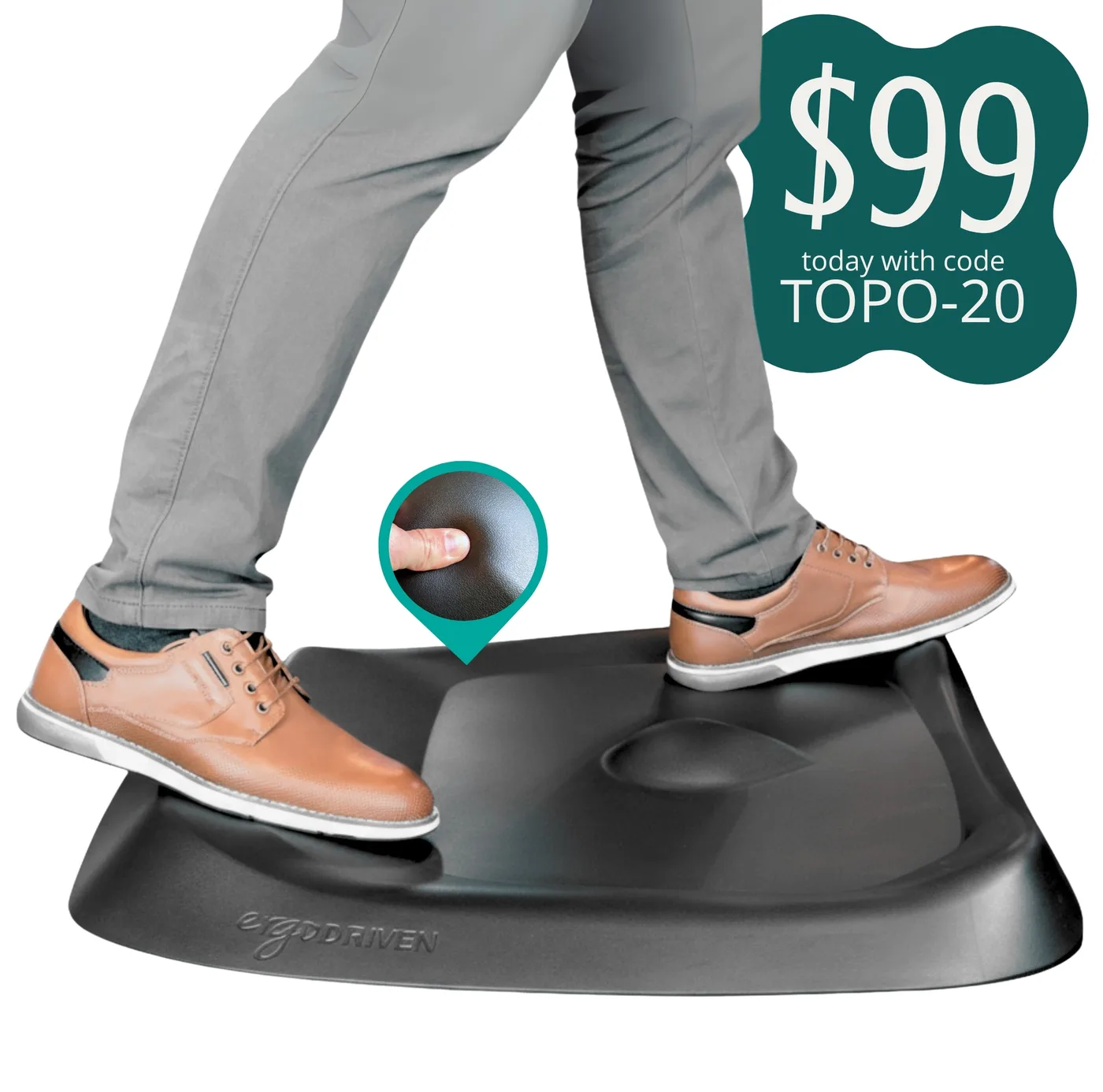
Ergodriven's insight is that a flat mat makes standing comfortable and therefore makes standing still comfortable, which removes the prompt to move. The Topo has raised edges, a mound, and various contours specifically so that your feet find new things to do. You end up shifting position every few minutes without deciding to.
Does it work?
Yes, and we were sceptical. Over several weeks of alternating between the Topo and a plain foam mat, the difference showed up at the ninety-minute mark: on the flat mat we were shifting deliberately and starting to want to sit; on the Topo we had been unconsciously moving all along and could keep going.
The specific features get used more than they look like they would. The outer ridges are good for stretching a calf. The centre mound suits standing with one foot up on it. The flat sections are for when you want to be still.
The material
Firm polyurethane rather than soft foam, which is the right choice. Soft mats feel wonderful for ten minutes and then become tiring, because your stabilising muscles are working to keep you upright on an unstable surface. The Topo is firm enough to stand on for hours.
After months of daily use ours shows no permanent compression, no crumbling edges and no yellowing. Cheap foam mats develop a permanent heel dent within weeks.
The practical annoyances
It is big. Roughly the footprint of a bath mat, and it does not fold or roll. There is nowhere convenient to store it, so it lives on the floor by your desk permanently.
Chairs do not roll on it. When you sit back down, either you move the mat or you position your chair off it. In a small room this is a genuine daily faff, and it is the main thing people complain about.
The raised edge. It is deliberately thick at the perimeter, which is great underfoot and a trip hazard if the mat sits across a route through the room. Think about placement.
What to wear on it
The mat changes what your feet want, and shoes matter more than people expect.
Barefoot or in socks is the intended experience and the one where the contours do the most: your feet read the terrain and adjust constantly.
Soft, thick-soled trainers largely cancel the effect. The cushioning absorbs the texture, and you end up standing on an expensive flat mat.
Thin, flat-soled shoes are the compromise that works if you cannot be barefoot.
Slippers with a hard sole are the worst of both: no feedback and no grip on the raised sections.
If you are buying this and you work in trainers, try it barefoot for a day before deciding it does not do anything.
Price, and the alternative
$119 for the standard size, $139 for the larger version. A plain foam anti-fatigue mat from a hardware shop is a third of that.
Our honest assessment: the flat mat delivers perhaps 70% of the benefit. If you stand for half an hour a day, buy the cheap one. If you stand for two or three hours a day, the difference in how your feet feel at the end of the day is worth the money, and the durability difference means the price gap narrows over a few years.
Ergodriven offer a 90-day satisfaction guarantee, which makes trying it low-risk.
Where the mat fits in the wider picture
Standing well is a stack, and the mat is only one layer of it.
The desk height has to be right, or you will lean and no mat will save your lower back. Elbows at roughly ninety degrees, wrists straight.
The screen has to come up with the desk, which is the argument for a monitor arm rather than a stack of books.
Shoes, or their absence, change what the mat does — see above.
And the single most important variable is not equipment at all: how long you stand before you sit down again. Most guidance lands somewhere around alternating every half hour to hour, and the Topo's contribution is that it makes the standing half of that cycle sustainable rather than endured.
Verdict
8.4. One of the few accessories on this site that changes how a working day feels rather than how a desk looks.
What holds up
- The contours genuinely prompt small position changes without you thinking about it
- Thick enough to matter on a hard floor, firm enough not to feel like standing in sand
- Durable polyurethane — no permanent dents after months of use
- 90-day satisfaction guarantee and free shipping
What wears thin
- Large, and it does not roll up or store anywhere convenient
- Wheeled chairs will not roll over it, so it has to be moved to sit down
- More expensive than a plain foam mat that is 70% as good
- The raised edges are a trip hazard at the edge of a walkway