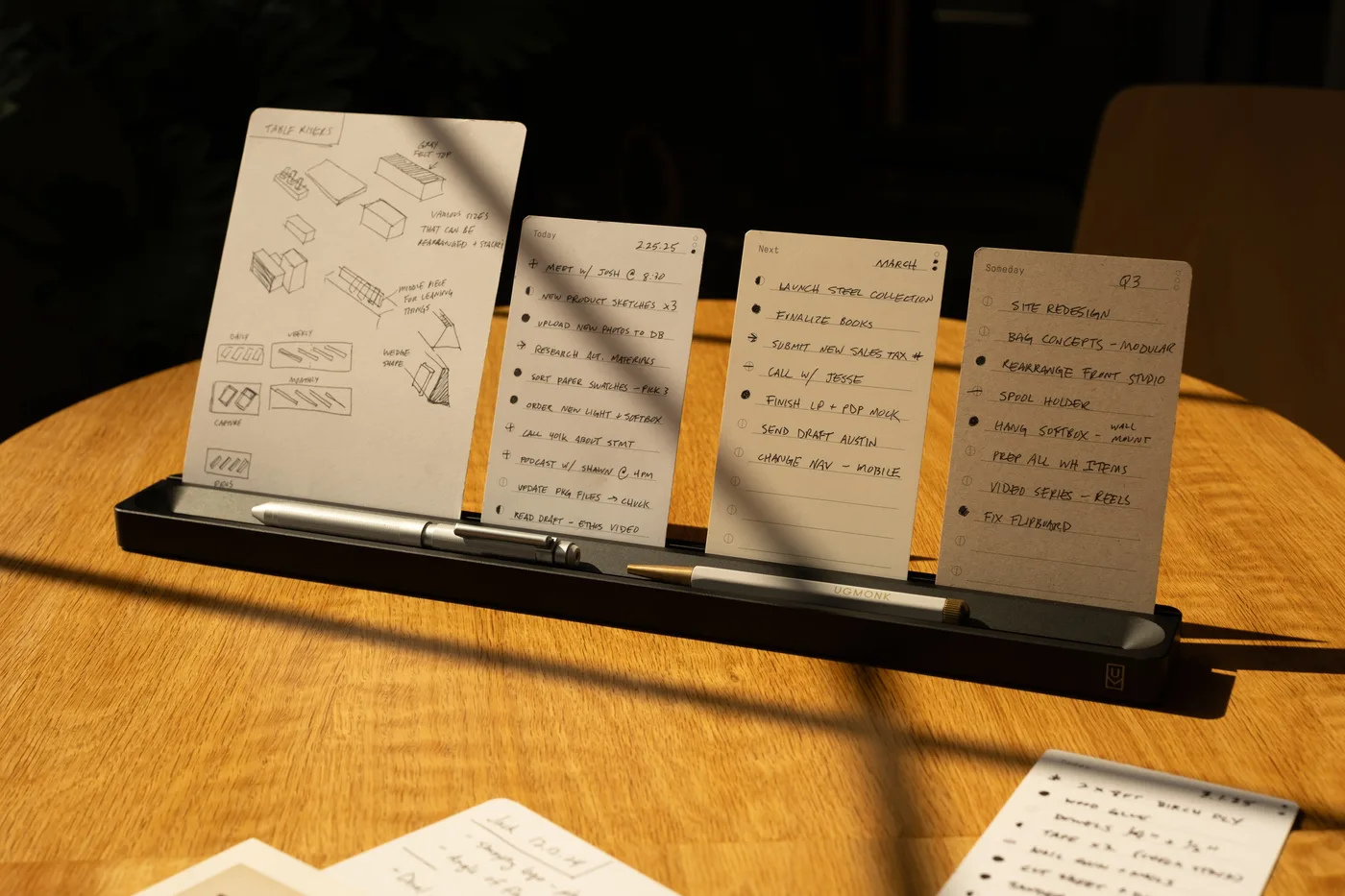
The premise
Desks accumulate small objects: pens, a phone, keys, cables, a notebook, headphones, a pair of glasses. Most of them end up in a drift along the back edge, and every few weeks you push them into a pile and feel briefly better.
Gather is a set of machined trays, cups, stands and dividers that attach to each other magnetically, so you can build a fitted home for exactly the things you own. Change your mind, pull a module off and put it somewhere else.
The build
This is where the money is and it is not a swindle.
The wood is solid walnut, not veneer, with edges eased by hand and a finish that feels like furniture rather than like a product. The aluminium is properly machined with clean anodising. The magnets are strong enough that modules stay attached when you slide the whole assembly across a desk, and weak enough to separate deliberately.
Nothing about it is stamped, glued or pretending. In a category dominated by injection-moulded plastic and bamboo-look bamboo, that stands out.
The pricing problem
Gather is sold as modules. A tray here, a pen cup there, a phone stand, a cable holder. Each individual piece looks reasonable.
The total does not. A configuration that genuinely organises a working desk — a base tray, a couple of cups, a phone dock, a cable module — runs well past $150 and can go much further, and because you buy it incrementally, the total arrives in instalments you notice less than you would notice one invoice.
That is not dishonest; it is how modular systems work, and it is exactly why they work commercially. Our practical advice: write down the objects you want to home before you open the configurator, buy the modules for those, and stop.
Does it change anything?
Honestly, yes, for a certain kind of desk.
If your desk holds a laptop and a mug, you do not need this and no amount of walnut will change that. If your desk holds a pen you use daily, a phone you glance at, headphones you pick up and put down, a notebook, a cable you plug in twice a day and a pair of reading glasses, then having a defined place for each of those things measurably reduces the amount of low-level searching you do in a day.
Whether that is worth $150 is a personal question and not one a review can answer for you.
The modules we would actually start with
If you are buying rather than browsing, this is a sensible first set.
A base tray to define the area and hold everything else. Without it the other modules are just objects on a desk.
One cup for pens, and only one — the second cup fills with things you do not use.
A phone dock if your phone lives on the desk, which for most people it does. This is the module that changes a habit rather than tidying an object.
A cable module at the back edge to catch the charging cable you plug in twice a day. This is the one people add last and should add first.
Stop there. Live with it for a month. Anything you still find yourself hunting for is a candidate for module five.
Care
Walnut marks. A wet glass left on a tray leaves a ring, and the oiled finish will show it. It can be sanded and re-oiled, which is more than can be said for plastic, but it needs the thought.
The pale aluminium shows fingerprints in a way the darker anodising does not.
Availability
Ugmonk are a small operation making things in batches. Popular modules go out of stock, and restocks are announced by newsletter rather than being constant. If you are building a set, expect to wait for a piece or two.
The alternative
A shallow wooden tray from a homeware shop, a heavy mug for pens, and a cable clip. Maybe $25 total. It will not look like this and it will do 80% of the job.
We are not being snide: that really is the alternative, and plenty of people should take it.
Verdict
7.5. Beautifully made, genuinely useful on a busy desk, and structured to keep selling you one more piece.
What holds up
- Solid walnut and machined aluminium; the finish is genuinely furniture-grade
- Magnetic modules rearrange in seconds and stay put once placed
- The system grows — buy a tray now, add a pen cup later, nothing is wasted
- Small footprint for what it holds
What wears thin
- Modular pricing makes the total creep; a useful configuration is not cheap
- Solves a problem you may not have if your desk holds three objects
- Walnut marks, and the pale aluminium shows fingerprints
- Shipping and availability can be slow — it is made in small batches