Who this is for
There is a specific person who should buy a desktop converter, and a much larger group who buy one and should not have.
Should: you rent, and the desk belongs to the landlord. You work in a shared office and the furniture is not yours to change. Your desk is a family heirloom, or built in, or a door on trestles that you like. In all these cases a converter is the only way to stand up at work, and this is the best one we have used.
Should not: you own a normal desk and could replace it. An Autonomous Desk Core is $349 — less than this converter — and it turns your whole desk into a standing desk instead of putting a large object on top of one. Converters exist because of constraints. If you do not have the constraint, buy the desk.
Setting it up
There is nothing to set up. It arrives assembled, you lift it onto the desk, and it works. For a category where "some assembly required" usually means an hour and a spare person, that is genuinely notable and it is the Pro Plus's best quality alongside its stability.
It is heavy. Getting it out of the box and onto a desk is a two-person job, and once it is placed you will not casually move it. That weight is not an accident — the base is deliberately weighted so the thing does not tip when raised with two monitors on it.
In use
The lift is a spring-assisted mechanism Vari call a rowing lift: you squeeze two handles at the sides and pull up, and the assistance means you are not deadlifting your monitors. It is smooth, it stops where you let go, and it takes about two seconds.
Stability at full height is the best of any converter we have tried. The mechanism is a proper parallel lift rather than a scissor arrangement, and the top does not rock when you type. Cheap converters are miserable at height; this one is not.
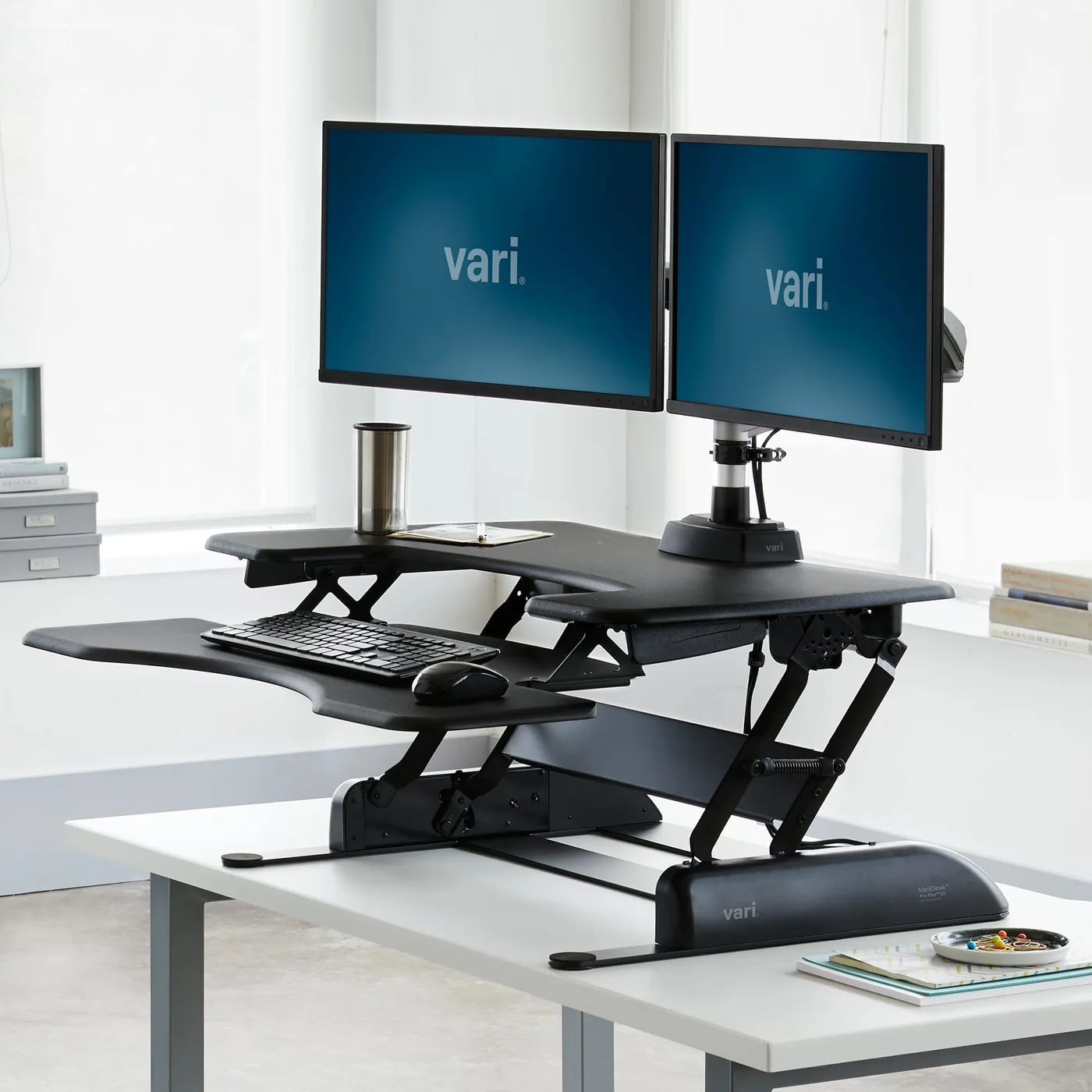
The two-tier design puts the keyboard on a lower deck below the monitor surface, which is correct and which a surprising number of competitors get wrong by putting the keyboard on the same plane as the screen.
Doing the height maths before you buy
A converter's usable standing height is your desk height plus its lift, and people skip this calculation constantly.
Measure your desk to the top of the surface. A typical fixed desk is around 73 to 75 cm. Add the lift and you get the top of the raised work surface.
Now measure the height of your elbows when you stand with your upper arms relaxed at your sides and your forearms level. For someone around 1.75 m that is usually 100 to 105 cm, and this clears it easily. Above about 1.90 m the arithmetic gets tight.
If the numbers do not work, no amount of good engineering will fix it, and a proper sit-stand desk that starts from the floor is the only answer.
The cost nobody prices in
Desk space. The Pro Plus occupies a 36-inch-wide rectangle of your desk permanently — not just when raised, but at every height, because it is sitting on the surface. On a 60-inch desk you lose the middle of it. On a 48-inch desk you lose most of it.
Anything that does not live on the converter — a notebook, a mug, a pile of paper — lives around it, in a narrowing border. Over a few weeks this is the thing that wears on people, more than the price.
Vari sell wider and narrower versions; the 36-inch is the middle and the one most people want. Going narrower to save desk space starts to compromise what fits on it.
The other limitation
It raises everything together. Some tasks are better standing with the keyboard up and the screen where it was; some people want to stand and read without the keyboard in the way. A converter has one configuration and you get it.
Warranty
A lifetime warranty on a mechanism with springs in it is an unusually strong statement, and free returns within thirty days make trying one low-risk — which matters on an object this heavy, because returning a converter you dislike is otherwise a genuine ordeal.
Verdict
A 7.7. Very well made, and solving a problem most readers could solve better by buying a different desk. If you cannot buy a different desk, this is the one.
What holds up
- Arrives fully assembled — lift it on, put your things on it, done
- Weighted base and thick steel make it genuinely stable at height
- Two-tier design keeps the keyboard below the screen, which many rivals get wrong
- Lifetime warranty and free returns within 30 days
What wears thin
- Occupies a large rectangle of desk permanently, at every height
- Costs more than several complete electric standing desks
- Heavy and awkward to reposition once placed
- Raises everything together — you cannot stand with just the keyboard up